
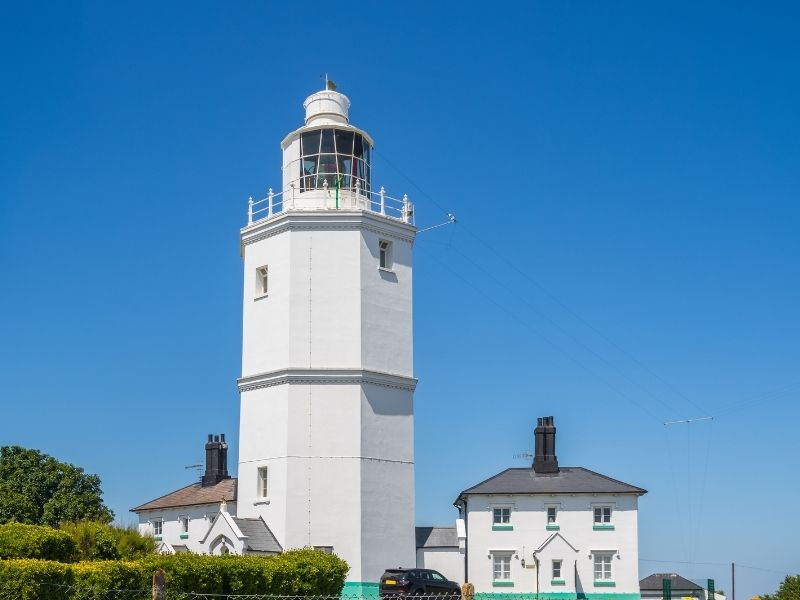
North Foreland Lighthouse stands on top of a chalk headland in Broadstairs, warning ships off the treacherous Goodwin Sands seven miles off the coast to the east and the less infamous Margate Sands to the north. It also marks the junction of the Dover Strait and the Thames Estuary for navigators.
This post may contain affiliate links. You can read my affiliate policy here.
A light was first exhibited on the North Foreland in 1499, a swape light consisting of a long pivoted beam with a basket containing an open fire.
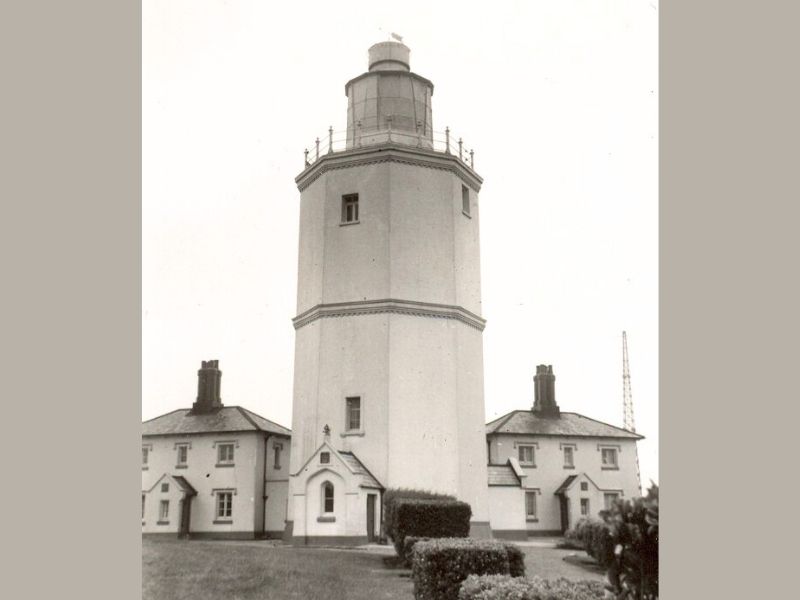
The first real lighthouse built on the Foreland was erected in 1636. Built by Sir John Meldrum, the two-storey octagonal tower was made of timber, lath, and plaster. However, in 1683, it caught fire and burned down.
A new 34-foot-tall brick, stone, and flint lighthouse was built in 1691. It carried a fire basket and exhibited a fixed white light. In 1793, it was heightened by the addition of two more storeys, and the coal-fired beacon was replaced by eighteen Argand oil lamps with circular wicks.
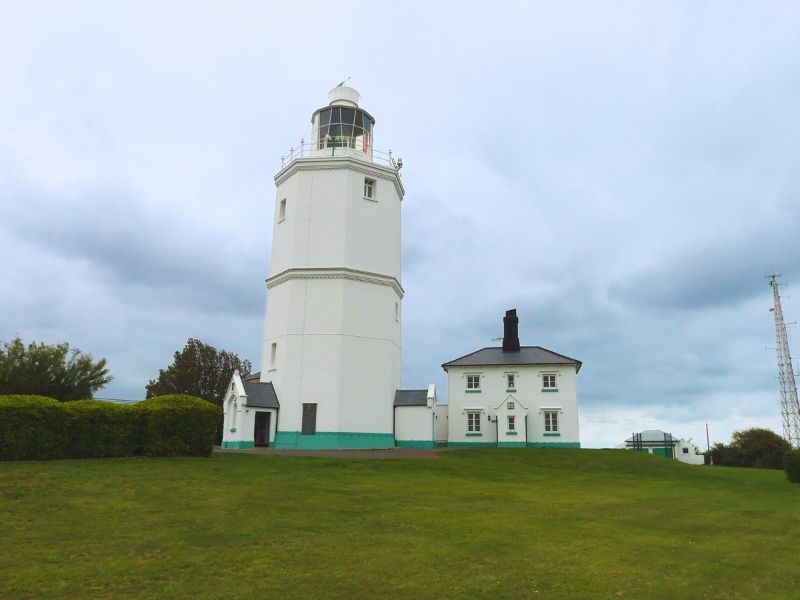
Trinity House purchased the North and South Foreland Lighthouses. In 1872, electric power was introduced to the North and South Forelands on the instruction of Michael Faraday, then Trinity House’s scientific adviser. These became the first lighthouses in the world to be electrically powered.
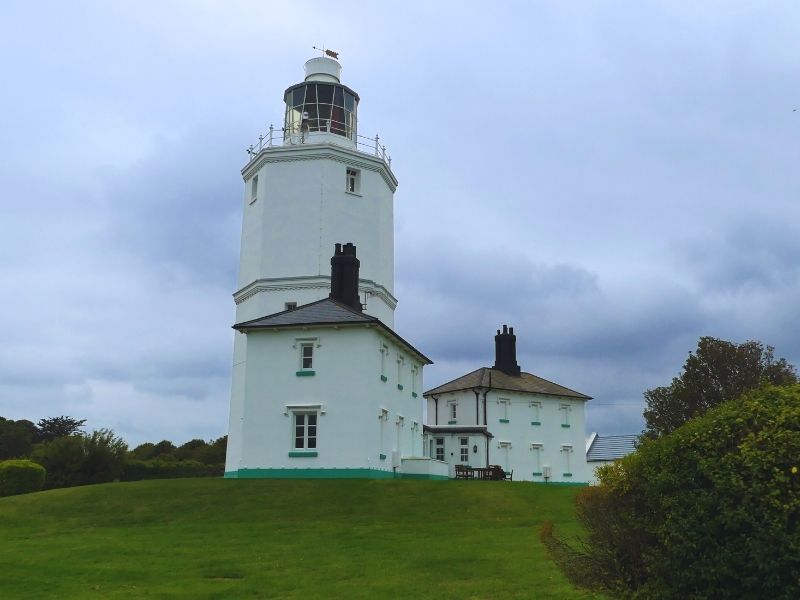
The lighthouse was further heightened in 1890 when a lantern was built on the top of the tower to house the light itself. It now stood 85ft high.
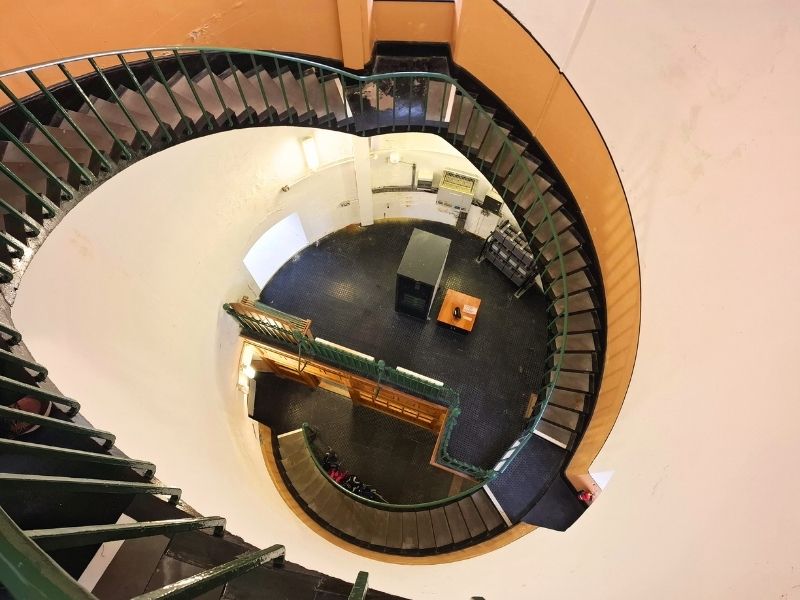
On 26th November 1998, North Foreland became the last lighthouse in the British Isles to be automated at a ceremony attended by the Deputy Master of Trinity House, His Royal Highness The Duke of Edinburgh. This brought to an end almost 400 years of lighthouse keeping around the British coast

Broadstairs is a charming seaside town known for its sandy beaches and Victorian architecture. The lighthouse is located on a private estate, and while the tower is not open to the public, it is visible from the road. The lighthouse is adjacent to North Foreland Golf Club.
Nearby Viking Bay is one of the town’s most popular beaches, and Bleak House, where Charles Dickens wrote much of his novel David Copperfield, is located in Broadstairs.
North Foreland is not open to the public, but it is easily viewed from the roadside, and there is a car park nearby at Joss Bay.


